A summer weekend on Deer Creek
I keep alternating between fishing notoriously hard waters—going three or four hours without seeing a fish, returning home thoroughly skunked—and seeking some form of cosmic revenge by terrorizing small trout that have never seen an artificial fly in their life.
After the latest therapy session at my local fly shop, the doctor’s orders included a visit to Deer Creek. Deer Creek rang a bell. I had first heard of it after the Grizzly Peak Fly Fishers organized an outing I couldn’t join, and that’s how I learned it promised something I don’t often get to experience: reliable dry-fly fishing within half a day’s drive. It’s not like Deer Creek is close to home either. On a good day, Chico is two hours and forty minutes away from Oakland, and from there it’s another forty-five before you reach trout water. But, at least you are in Chico, a fairly civilized place as measured by the proximity to a Trader Joe’s.
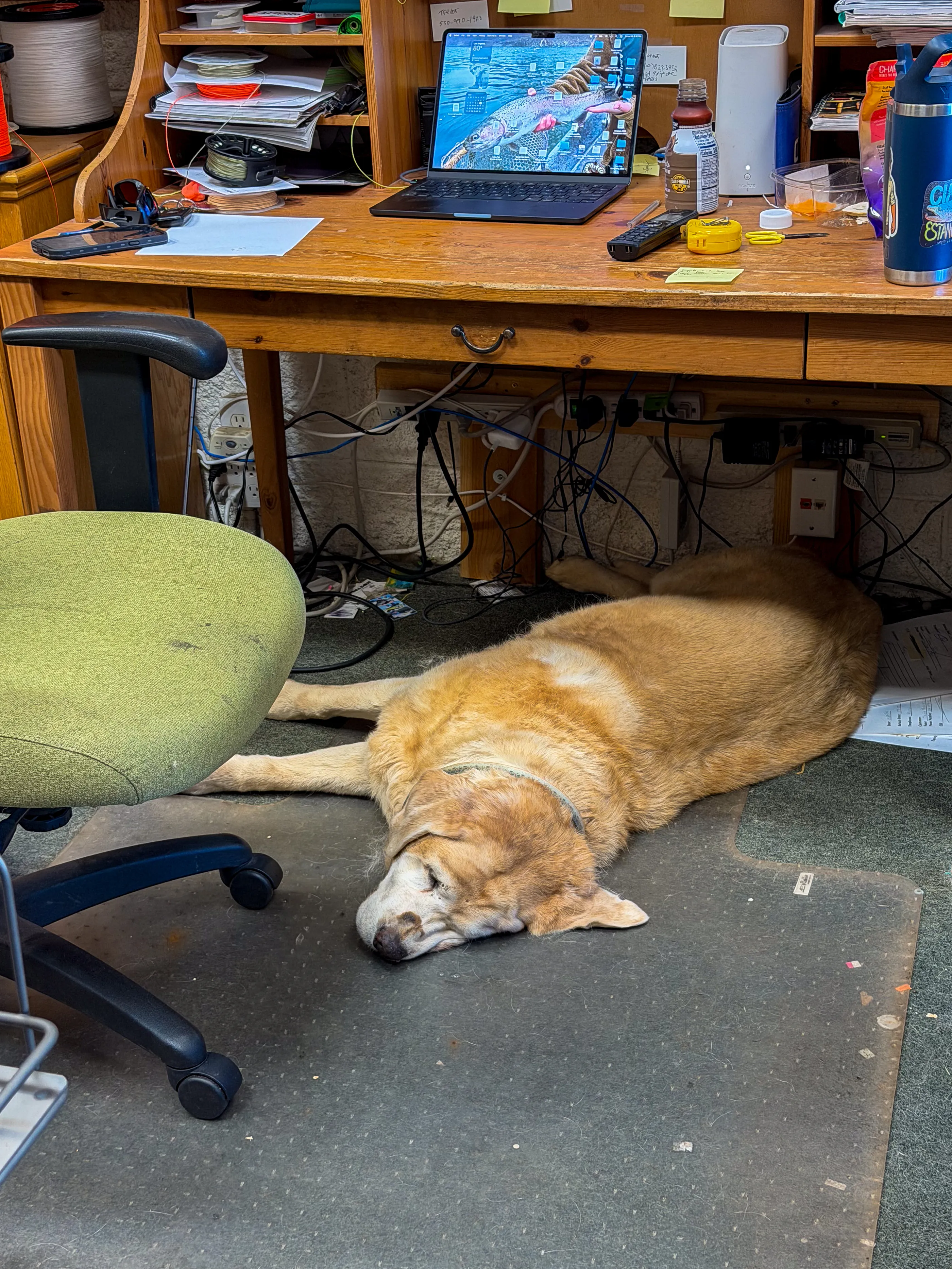
I arrived in town and headed straight into Fish First, where I was greeted by Twinkie and Mac. Twinkie is the perfect shop dog: big, slow, and food-motivated. Mac is a hearty guy with a big and genuine smile. He has been serving the area for over twenty years; he lives and loves fishing. Sometimes, stopping at a fly shop is just an excuse to meet someone like Mac. After exchanging some banter, he helped me fill my fly box with seasonal river offerings: #14–16 Missing Link in amber and yellow to imitate the adult caddis and yellow sallies found in the area during the summer months, plus a couple #14 Chubby Chernobyl in purple for dry-droppers.
While in town, make sure to resupply: Highway 32 is absolutely devoid of any store or service, with the closest businesses being in Chester, 30 minutes further north. I was only briefly in Chico, but a few places stood out: coffee and pastries at Stoble (a roaster and café carrying baked goods from Camina), the Chico farmers market (Saturday mornings start at 7am), and the legendary Sierra Nevada Taproom.
Off we go to fishing. Most of Deer Creek is fast, cold, and rocky. It’s a steep freestone creek fed by snowmelt, which makes the water cold enough to be fishable even during the height of summer. While I was there the water temperature fluctuated between 55 and 60°F, while outside temperatures were in the 90s. All of this made the “wet” part of wet wading enjoyable, though the wading itself was not the easiest: I was scrambling over rocks the whole time, trying to find secure footing between one slick boulder and the next. Carrying a wading staff is never a bad choice on Northern California water.
All these conditions also make Deer Creek’s fish both plentiful and small: gravel, well-oxygenated water, and fairly stable flows make for great spawning grounds, while year-round cold water, remoteness, woody debris and boulder pockets lead to lower stress and better survival. Better survival brings more mouths to feed, which results in fewer calories per fish. Add to that the scarcity of really deep pools where a fish can grow large undisturbed, and you’ll find that most don’t get to grow much past the 6–10” range, with the biggest reaching 16”.
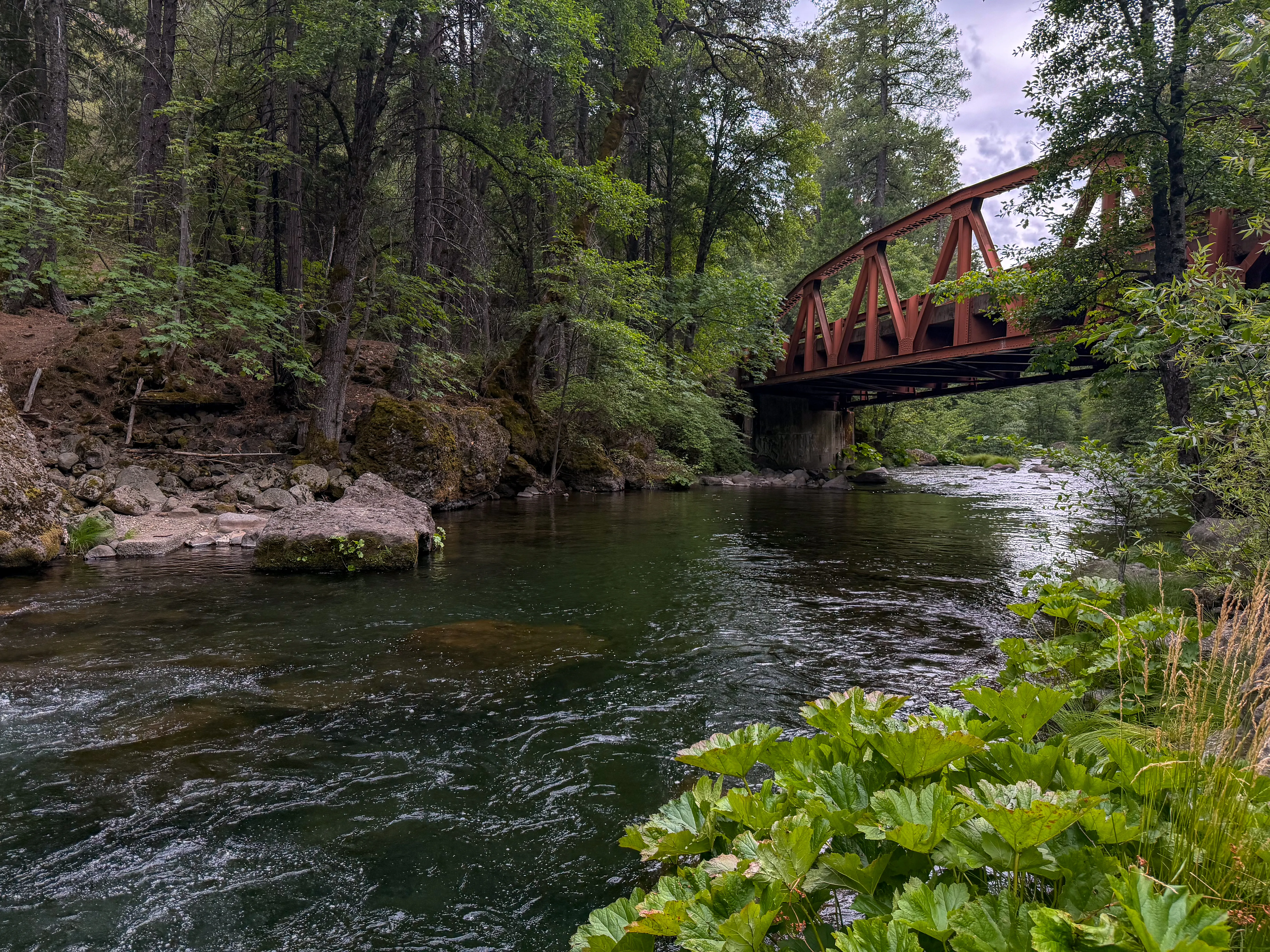
Access to the catch and release water is mixed. Coming from Chico you’ll eventually cross the unmissable rust-colored bridge that marks your first encounter with Deer Creek. The turnout right after the bridge provides the easiest access you’ll find; you’d think that would spoil the fishing but no, it doesn’t. I’ve had plenty of success casting right there in those pools and pockets.
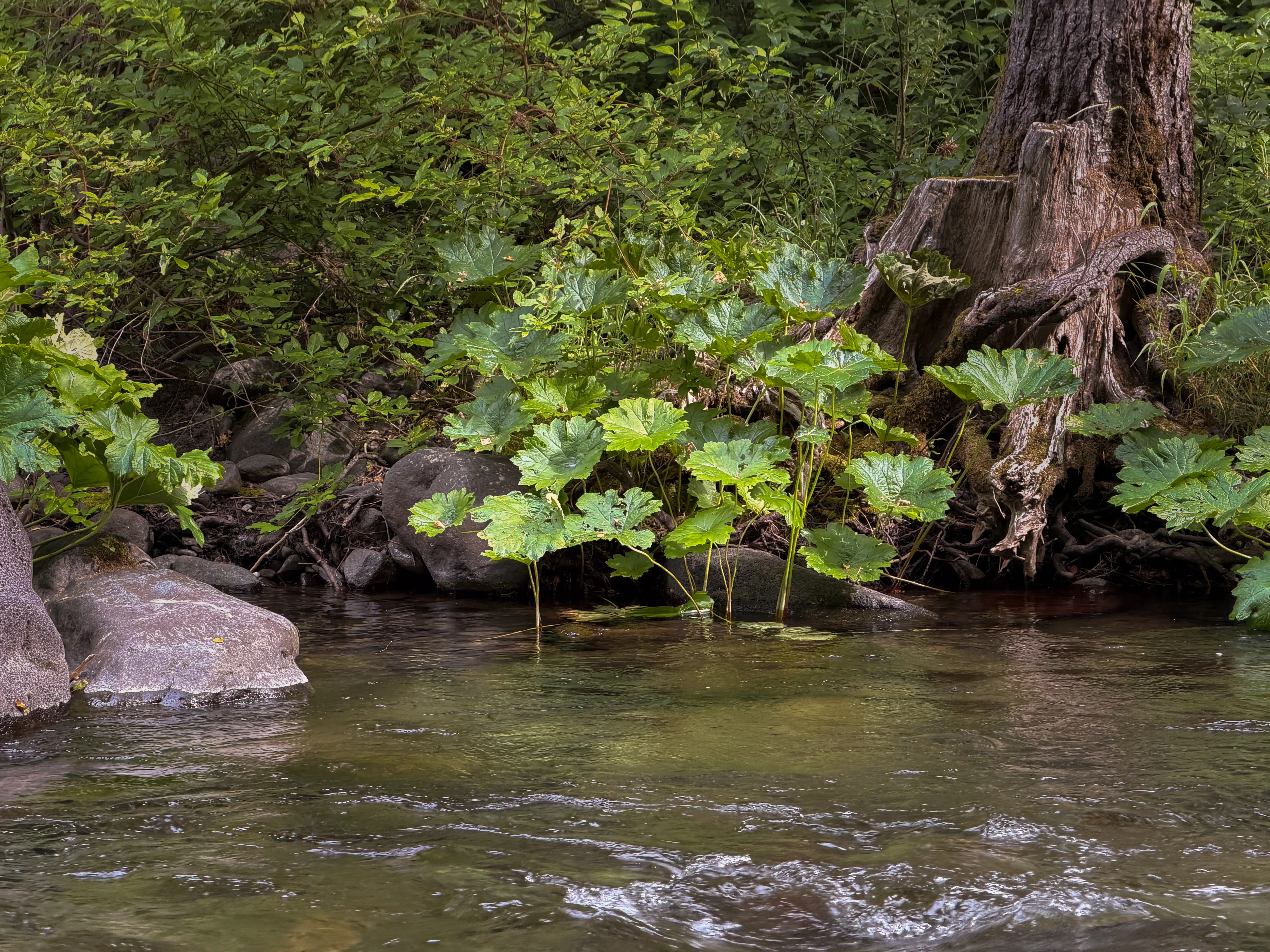
North of the bridge, the easiest access will be at Potato Patch Campground, which is where I started. The whole time I was there I did not encounter other anglers, but the campground was lively and populated and kids and families were enjoying the creek, so I waded a short distance upstream and there I was able to start hooking into fish right away. Besides the campground and a turnout, there aren’t many obvious places to pull over and fish without parking shenanigans and at least some hiking through the brush and down the canyon wall.
South of the bridge, the highway completely diverges from the creek. Here you have two choices: leave the car behind and hike the trail that follows the creek, or drive twenty minutes on an unpaved road to reach another bridge. I opted to drive the unpaved road known as Dumb Deer Road, which was doable even with my trusty, decade-old Toyota Corolla. The “entrance” is marked by a tree with a big spray-painted letter K on it, or for the more data-minded it’s at 40.152167, -121.590611.
Keep in mind this is an even more remote area, so come equipped. I arrived eager to scout a path down the creek, and walking back to my car I found two large stray dogs next to it. I saw them, they saw me, and—after a moment of mute and mutual acknowledgement—they started growling and barking. With nowhere to go but my car, I slowly circled around them avoiding eye contact and managed to enter the car on the opposite side. Eventually they left, but knowing I had my knife with me brought me peace of mind.
From here, to get to the water you can hike down on your ass the near-vertical slope on the north-west side of the bridge. Or, as I found out later, you can walk or take your car a little further: pass the bridge, take the first left into an even rougher road and follow it until you get to a wide, clear area. From there you can much more easily walk down to the water, no ass-scrambling needed.
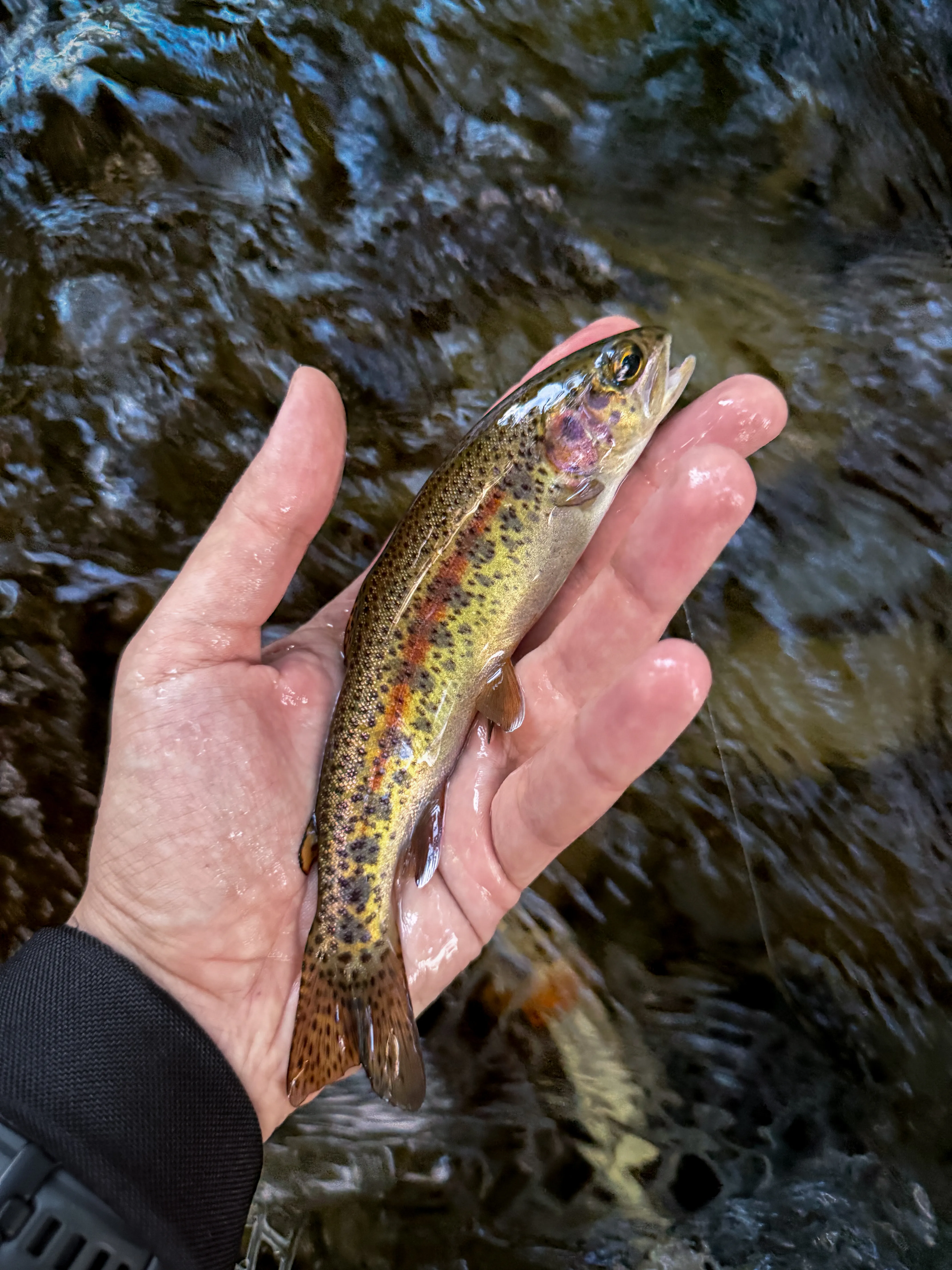
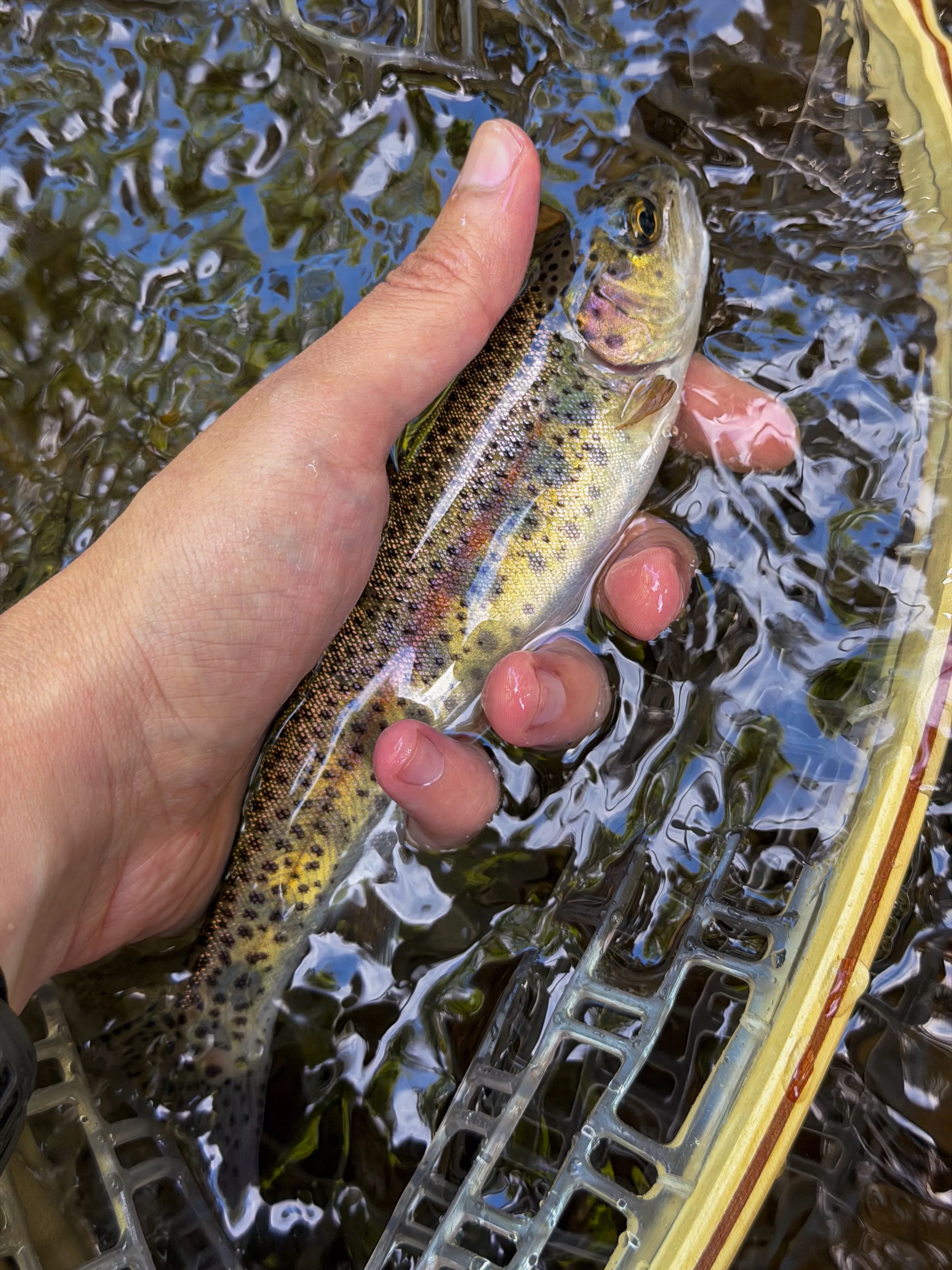
Overall, fishing Deer Creek was straightforward. I felt lucky catching a trout on my second cast upstream of the campground, and made sure to take a picture. That feeling didn’t last long, because as soon as I tried again I caught another, and then another. I stopped counting at seven, but I must have caught at least fifteen in just a couple hours. Most of them were on dry flies I picked up at the shop, but seeing how eager they are to swim to the surface from their deep hiding holes, I’m convinced almost any generic size #16 dry fly would have worked. For deeper pools I switched to high-stick nymphing—not changing the leader, not even adding split shot—mostly with beaded purple Prince Nymphs I already had, which proved popular. While fishing a particularly deep pool I hooked into a huge, empty caddis casing that fell in the current before I could take a picture. I fumbled through my box to find anything that would vaguely resemble what could have come out of that, put on a chartreuse Mop, and caught the biggest fish of the day (maybe a 12″, mind you). The creek at Dumb Deer Road is wider, but fishes the same. Given how remote it is and the fact that the fish are not more plentiful nor bigger, I’m thinking that next time I’ll stick to the more accessible area near the bridge.
The fact that Deer Creek is so easy makes it a great place for beginners, and not just because you are guaranteed not to come home skunked. Here you can learn how to wade properly: it’s challenging, but not dangerous. You can focus on casting, switching flies and tying knots without obsessing over matching the hatch or achieving the most immaculate drift. The fish are hungry and you’ll have plenty of chances to practice setting the hook, but if you miss they will not come back for more.
As for me, Deer Creek wasn’t quite what I was looking for, but I’d be lying if I said I didn’t have plenty of fun. After enough weekends spent chasing impossible trout, fishing a creek full of eager little wild rainbows swimming in crystal-clear water winding through beautiful scenery is good for the soul. As for next time, I’m thinking a return visit to the Upper Sacramento is due.
Field Log
- Location
- Deer Creek, California (Hwy 32)
- Date
- July 2025
- Water temp
- 55–60°F
- Species
- Wild rainbow trout
- Flies
- #14–16 Missing Link Caddis (Amber, Yellow), #14 Chubby Chernobyl (Purple), #18 Prince Nymph (Purple), #12 Mop (Chartreuse)
- Rod
- 9ft 5wt Echo Lift
- Reel
- Lamson Liquid S 5+